
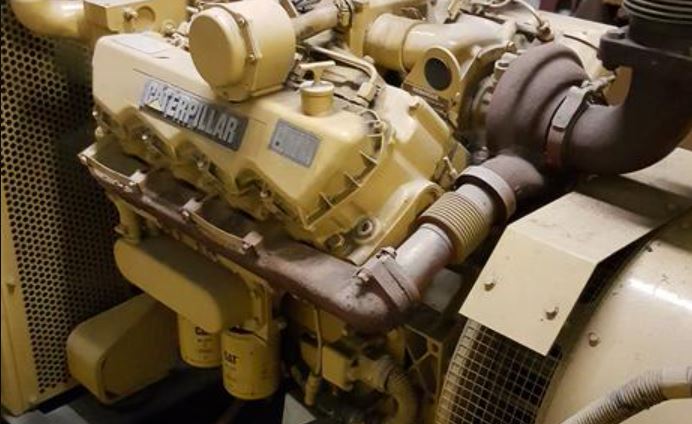
The Caterpillar 3208 is more than just a piece of iron; it is a polarizing icon of mid-range diesel engineering. Produced from the mid-1970s through the late 1990s, this V8 workhorse powered everything from school buses and delivery trucks to sportfishing boats and agricultural combines.
The “Throw-Away” Myth
However, a cloud has always hung over its reputation—the persistent myth of the “throw-away engine.” Because the 3208 lacks replaceable cylinder liners, many technicians viewed it as a disposable asset. At Gigonsa, we see it differently. The 3208 is only “disposable” if you allow poor fuel quality and negligent maintenance to destroy it from the inside out. With the right protection strategy, this engine can defy its critics and deliver decades of reliable service.
In this comprehensive guide, we will dismantle the myths, analyze the technical vulnerabilities of the 3208, and provide a roadmap for maximizing the lifespan of this legendary V8.
 The 3208 requires a specific maintenance mindset due to its parent bore design.
Technical Anatomy of a Legend: The V8 10.4L Displacement
To understand why the 3208 behaves the way it does, we must look at its architecture. It is a naturally aspirated or turbocharged four-stroke diesel V8 with a massive 10.4L (636 cubic inches) displacement. Unlike the heavy-duty, slow-revving inline-six engines Caterpillar is famous for, the 3208 was designed to be compact, relatively lightweight, and high-revving.
Its V-configuration allows for a shorter crankshaft, which reduces the overall footprint of the engine—a critical feature for the cramped engine bays of 1980s trucks and marine vessels. But this compact design came with engineering trade-offs that dictate exactly how the engine must be maintained today.
Parent Bore Design: Why Cylinder Integrity is Everything
The most defining (and controversial) feature of the 3208 is its parent bore design. In a typical heavy-duty diesel (like the CAT 3406), the cylinders are fitted with removable “wet” or “dry” sleeves. If a cylinder is damaged, you simply swap the sleeve.
In the 3208, the cylinders are bored directly into the cast-iron block. While this makes the engine lighter and more rigid, it means there is no “reset” button. If a cylinder wall is scored by a broken ring or eroded by cavitation, the entire block must be removed and machined to an oversize diameter—or scrapped. This reality transforms cooling system maintenance and fuel purity from “suggested tasks” into “survival requirements.”
Naturally Aspirated vs. Turbocharged: Understanding Horsepower Variations (210 to 435 HP)
The 3208 was a master of disguise, appearing in various power ratings to suit different industries.
- Naturally Aspirated (NA): The base models usually hovered around 210 HP. These are known for extreme longevity because they operate under lower thermal stress.
- Turbocharged (T) and Aftercooled (TA): In marine applications, the 3208 was pushed to its absolute limits, reaching up to 435 HP.
While the high-horsepower versions offer impressive performance, they are significantly more sensitive to overheating and fuel contamination. As the power density increases, the margin for error in your maintenance protocol disappears.
The Critical Weakness: The Sleeve Metering Fuel System
If the parent bore design is the engine’s “limitation,” the Sleeve Metering Fuel System is its “Achilles’ heel.” This mechanical injection system is a masterpiece of 20th-century engineering, but it is notoriously intolerant of anything other than pristine diesel fuel.
Why Diesel is the Sole Lubricant for Your Injection Pump
Inside the 3208 injection pump, the moving parts—specifically the plungers and sleeves—operate with incredibly tight tolerances. Unlike modern engines that might use specialized lubricants, the 3208 relies entirely on the lubricity of the diesel fuel itself to prevent metal-on-metal contact.
When you introduce water or low-quality fuel into this system, you aren’t just “dirtying” the engine; you are removing its only source of protection. Microscopic wear on these sleeves leads to “hunting” (unstable RPMs), difficult starts, and eventually, catastrophic failure.
The Mechanics of Runaway Engines: How Water Causes Sticking Sleeves
This is where the conversation turns from “expensive repair” to “safety hazard.” Many competitors mention that water is “bad,” but they rarely explain the physics of a runaway.
In the 3208’s fuel system, the “sleeves” move up and down to control the amount of fuel delivered to the cylinders. If water enters the pump, it causes flash-corrosion or “stiction” between the sleeve and the plunger. If these sleeves get stuck in the full-fuel position, the engine will begin to accelerate uncontrollably.
Because it is a diesel, it will keep revving until the valves float, the rods throw, or the engine literally explodes. This is a “runaway” scenario. By using an AK Purifier to remove 99% of water before it ever reaches the pump, you aren’t just saving money; you are preventing a high-speed mechanical suicide.
Common Failure Modes and Root Cause Analysis
Understanding how a 3208 fails is the first step toward making sure yours never does. Most failures are not “random”; they are the result of cumulative neglect.
Managing Blowby and Breather Loop Obstructions
As a 3208 ages, it is normal to see a small amount of “haze” or blowby from the crankcase breather. However, if the breather tube becomes obstructed by oily sludge or debris, crankcase pressure builds up. This pressure can blow out main seals or, worse, force oil into the intake, potentially causing a secondary runaway condition. Regular cleaning of the breather system is a non-negotiable task.
Head Gasket Vulnerabilities and Overheating Prevention
The 3208 has a long cylinder head, and thermal expansion is a constant reality. If the engine is overheated even once, the head can warp, leading to head gasket failure. Because there are no liners to help dissipate heat from the top of the block, keeping your cooling system (radiators, heat exchangers, and thermostats) in peak condition is vital.
Cavitation in Non-Sleeved Blocks: A Silent Killer
In the world of diesel maintenance, cavitation is the silent killer. It occurs when tiny air bubbles form and collapse against the outside of the cylinder wall in the water jacket. These microscopic “implosions” eventually blast tiny holes through the cast iron.
In a linered engine, you just replace the liner. In a 3208, a cavitation hole means water enters the combustion chamber, and the engine block becomes a boat anchor. While maintaining supplemental coolant additives (SCA) is essential, there is a secondary defense: combustion efficiency. A clean-burning engine, powered by purified fuel from an AK Purifier, experiences less localized “hot spotting” on the cylinder walls, reducing the thermal stress that exacerbates cavitation.
 Advanced filtration is the key to extending the life of legacy engines like the 3208.
The Longevity Protocol: Advanced Fuel Purification with AK Purifier
At Gigonsa, we believe that the 3208 is a 20,000-hour engine trapped in a 5,000-hour maintenance cycle. The difference between those two numbers is the quality of the fuel.
Eliminating 99% of Water and Sediment Before the Primary Filter
Traditional paper filters are “defensive”—they catch dirt until they clog. The AK Purifier is “offensive.” Using advanced centrifugal technology without internal moving parts, it spins the fuel to separate 99% of water and heavy sediments.
The Strategic Advantage: By the time the fuel reaches your primary CAT filter, it is already cleaner than what comes out of most gas station pumps. This prevents the “saturation” of paper filters, which often allows microscopic water to pass through once the filter is full.
Extending Injected Component Life Beyond 2000 Hours
In many industrial applications, 3208 injectors are replaced every 2000 to 3000 hours as a “precaution.” With an AK Purifier, we have seen users double these intervals. By removing the abrasive particles and corrosive water that score the injector nozzles, we maintain the “mist” spray pattern necessary for complete combustion, which in turn reduces carbon buildup and smoke.
| Feature | Traditional Filters | AK Purifier (Gigonsa) |
|---|---|---|
| Service Life | 250 – 500 Hours | Up to 15 Years |
| Maintenance | Constant Replacement | No-cost (Self-cleaning) |
| Water Removal | Variable/Absorption | 99% Efficiency |
| Warranty | None | 7 Years to Lifetime |
Comprehensive Maintenance Intervals for the 3208
To keep your 3208 running until 2040 and beyond, you must adhere to a strict schedule. This engine does not “self-heal.”
The 250-Hour Oil and Filter Standard
Because the 3208 is a high-volume oil engine, it is prone to soot loading. Change your oil and filters every 250 hours (or 3,000 to 5,000 miles). Always use a high-quality 15W-40 diesel oil and never skip the fuel filter change—unless, of course, you have an AK Purifier, in which case your filter life will be significantly extended.
Periodic Valve Lash Adjustments and Timing Verification
Many owners forget that the 3208 has a mechanical valvetrain that requires manual adjustment. We recommend checking the valve lash every 1000 hours. Proper valve clearance ensures the engine “breathes” correctly, preventing dropped valves and improving fuel economy. Similarly, checking the fuel injection timing ensures you aren’t “retarding” the combustion, which causes excessive heat and smoke.
Frequently Asked Questions about the Caterpillar 3208
1. Is the Caterpillar 3208 a good engine?
Yes, provided it is not over-propped (in boats) or overheated. It is a reliable, simple engine that is easy to work on, making it a favorite for remote locations.
2. Why do people call it a “disposable” engine?
Because it lacks cylinder liners. However, with modern machining and proper maintenance (like fuel purification), these blocks can be bored and reused multiple times.
3. How does cold weather affect the 3208?
Between 6°C and -10°C, condensation forms rapidly in half-empty fuel tanks. This introduces water into the system, leading to hard starts and injector wear. The AK Purifier is essential in extreme climates to strip that condensation out before it reaches the engine.
4. Can I add a turbo to my naturally aspirated 3208?
It is not recommended. The turbocharged versions have different pistons, cooling capacities, and oil squirters to handle the extra heat.
A Legacy Asset
The Caterpillar 3208 is a legacy asset. In an era of overly complex, sensor-heavy engines, the 3208 represents a time when mechanical durability was king. By addressing its few biological weaknesses—specifically its sensitivity to fuel contamination and cooling—you can ensure this “legend” continues to power your business for years to come.
Would you like me to create a customized installation map for an AK Purifier on your specific Caterpillar 3208 model to start protecting your investment today?
Request Installation MapRelated Articles
Water: The Worst Enemy of Diesel
Understand why even microscopic amounts of water can be catastrophic for injection systems like the 3208’s.
Read More
Centrifugal Filtration vs. Traditional Filters
A deep dive into why relying solely on paper filters is an outdated strategy for modern engine protection.
Read More
Extend Diesel Engine Life up to 15 Years
Learn the comprehensive protocols that allow legacy engines to operate reliably for decades.
Read More